The Green Hybrid City - City of the Future
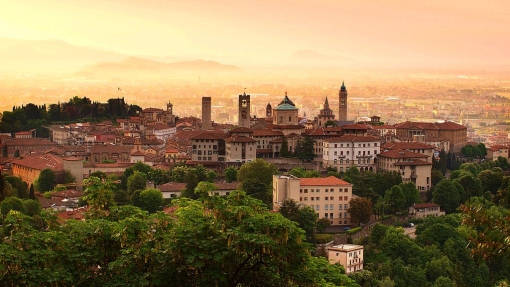 |
| Without groves of trees cities lack beauty: Image source:
|
Several earlier posts in this blog have mentioned it is
better to live in a rural or country area surrounded by greenery rather than in crowded
cities. An earlier post proposed a configuration of farm lands (termed AM farms
for identification) that combined some of the advantages of urban living with
rural life. However many persons are still compelled to, or prefer to, live an
urban life in big towns or cities. That is just as well because the population
of our planet is now around seven billion and with such a heavy population it
is a necessity. A large proportion of humans must continue to live in cities. However,
it is possible to live amidst greenery even in urban settings provided cities
are designed for it. This post proposes the configuration of a city that brings
some of the advantages of a rural life along with its greenery to towns and
cities. The present configuration of a hybrid agricultural –urban city adds
some of the advantages and charm of
rural life to a modern city just as the AM farms added urban advantages
to a rural area.
 |
| A Section of the Proposed Green Hybrid City |
For simplicity the illustration has shown a rectangular grid. In actual practice it would be better to add curves to some of the roads to enhance natural charm, advantage and benefits. With curved roads the size of individual blocks would vary. What sort of curves to use depends on the lay of land. In any area to be urbanized it is necessary to map out the channels of rain water flow and lay the roads along that for easy rain water drainage without blocking such channels with buildings. This minimizes the need of raising height of lots and portions later by mud filling to create flow. When this is done some roads in any new urban area are automatically and naturally curved and some of the soil is left in its original natural state with healthy top soil built over thousands of years. Such a city also then does not face severe water logging problems in rainy season as many do in developing countries with incomplete engineering compromised further by callousness and corruption.

No Extra Land Required
One may ask as to how much extra area the proposed hybrid city requires as compared to a traditional one. Since about half the urban area goes into roads and other open spaces on the average, dividing the remaining half between green and constructed spaces causes an increase of approximately 50 per cent i.e. approximately a large hundred square mile city would become less than 150 square miles. However if mandatory parks, playgrounds and commons were some of these reserved green spaces then land requirement may be around 125 square miles and if a higher density of population is permitted in constructed space which is easily possible because of open green surroundings then land requirements may not be different from cities without this green design. In any case the additional land used is proposed to be used for beneficial agricultural use and thus is not wastage of earth’s precious resources.
The question that arises is that if adding green to a city
is so easy, why such cities rarely exist. The answer is greed. Some cities did indeed begin like that but eventually became crowded. Urban spaces
become expensive as a city grows and there is greed on the part of city
authorities as well as others to sell that land for profit. In order to develop
such cities the master plan has to be strictly maintained with a provision that
city authorities cannot convert green spaces for other use unless approved
by a two third majority of city dwellers in a city referendum.
It would be necessary to regulate usage of the
green agricultural lots to make them compatible with urban surroundings. Firstly
animals must not be permitted. The farming of food grains (wheat etc.) and oils
seeds (soy beans etc.) may also not be permitted in these small urban farms.
Rather their use must be reserved for vegetable, fruit and flower farming. The
latter are best suited for small farms. In order to ensure that the farm lots
are used appropriately their ownership must remain with the city. The city in
turn may lease these to interested parties for a few years at a time with the
provision that the lease would be cancelled if the lots are misused. Very
limited construction along the northern boundary of these farming lots may be
permitted e.g. a shop/restaurant of no more than 400 square feet with a 400
square feet studio apartment on the first floor for a possible farm hand or the
lease holder along with a temporary shed of no more than 600 square feet for
agricultural storage and use. The northern boundary is suggested here since
that causes least shading on the rest of the land.
Such a city would enjoy lush green surroundings. Note that
every housing lot is surrounded by green. It would also enjoy fresh fruits and
vegetables grown within the city. Existing cities can not be changed
substantially now but this blogger hopes that the present post will catch the
attention of some planners when new cities or extensions of existing cities are
being designed.
The present proposal adds rural jobs and the charm of a rural life to an urban one. Another post in this blog shows how urban charm can be added to rural life along with millions of sustainable jobs that do not vanish when the economy collapses. Check out the following link for it:
http://steamcenter.blogspot.in/2014/05/postmodern-designer-villages.html
http://steamcenter.blogspot.in/2014/05/postmodern-designer-villages.html
 |
| Image from : https://commons.wikimedia.org/wiki/File:FraxernVlbg1.JPG |
The Natural City
Whenever a new city is to be built it requires land, some of which may be ancestral land of farmers who can not be compelled to part with it. The approach them must be to notify the area as mixed agricultural cum urban, acquire the minimum necessary for roads and then purchase from farmers willing to sell until permitted green density is breached. Farmers that do not sell would be natural farm areas in the city. When green density is reached remaining sale of farms must be frozen so as to preserve green spaces.
Additional Advantages
An additional advantage is that sewerage and green component of garbage is then composted in several farm locations for use on farms within the city while other waste is led to a nearby sorting and recycling unit. Other waste water from homes too with minor treatment may be returned for farm use while for drinking water there would be a separate well treated fresh water supply. The farm areas are also ideally suited to place wind turbines owned by the city since these do not shade the ground for collecting energy required by the city while solar PV panels may be placed on roofs of homes and both forms of energy pooled for processing and returning to the city grid. Thereby transmission losses are nearly eliminated.
UPDATE: April 16, 2013: Today added a name of this city design for easy reference as AM cities in line with the AM rural design, since both design have an identical philosophy behind them.
Whenever a new city is to be built it requires land, some of which may be ancestral land of farmers who can not be compelled to part with it. The approach them must be to notify the area as mixed agricultural cum urban, acquire the minimum necessary for roads and then purchase from farmers willing to sell until permitted green density is breached. Farmers that do not sell would be natural farm areas in the city. When green density is reached remaining sale of farms must be frozen so as to preserve green spaces.
Additional Advantages
An additional advantage is that sewerage and green component of garbage is then composted in several farm locations for use on farms within the city while other waste is led to a nearby sorting and recycling unit. Other waste water from homes too with minor treatment may be returned for farm use while for drinking water there would be a separate well treated fresh water supply. The farm areas are also ideally suited to place wind turbines owned by the city since these do not shade the ground for collecting energy required by the city while solar PV panels may be placed on roofs of homes and both forms of energy pooled for processing and returning to the city grid. Thereby transmission losses are nearly eliminated.
 |
|
The New Roots mini-farm in the Bronx
is tucked alongside a busy thoroughfare. Byron Times / NY Times /
ReduxPictures,
|
UPDATE: April 16, 2013: Today added a name of this city design for easy reference as AM cities in line with the AM rural design, since both design have an identical philosophy behind them.
UPDATE: JUNE 2013: An interesting new video echos the philosophy of this urban concept at
http://www.youtube.com/watch?v=EzZzZ_qpZ4w&feature=share
UPDATE JULY 2015: The urban farming concept is spreading. See this recent report
http://thinkprogress.org/climate/2015/07/15/3670618/baseball-urban-farms/






Comments